
Edge AI vs Cloud Pool Cameras: Why On-Device Processing Wins in 2026
Cloud pool cameras add seconds of latency when every second counts. Learn why Pool Angel's edge AI Hub processes video locally for sub-2s alerts, privacy, and uninterrupted monitoring — a capability cloud systems cannot match.
When a child's head slips below the waterline, you have seconds — not minutes — to respond. The architecture behind your pool safety camera determines whether an alert reaches your phone in under two seconds or after a ten-second cloud round-trip that may arrive too late. In 2026, the pool safety market is divided between cloud-based AI systems that upload video to remote servers for analysis and edge AI systems that process everything locally on an on-premises Hub. The difference is not academic. According to the CDC, drowning can happen quickly and quietly — often in 20 to 60 seconds — and every second of delay in your alert pipeline directly reduces the window for a successful rescue. This guide explains the technical differences between edge and cloud processing, why latency matters in drowning detection, and why Pool Angel's on-device architecture is the only residential system built for life-or-death response times.
Why Architecture Matters More Than Marketing Claims
Most pool safety camera buyers focus on features: resolution, night vision, app notifications, subscription pricing. Those matter — but the single most important technical decision is where the artificial intelligence runs. If AI analysis happens on a remote server, your alert depends on video compression, upload bandwidth, server queue time, and return-path delivery. If AI analysis happens on a local Hub inside your home, the alert path is camera → Hub → phone over your local network. The CPSC 2025 Submersion Report documents an average of 357 fatal pool and spa drownings annually among children under 15 in the United States, with thousands more nonfatal submersion injuries requiring emergency care. No camera prevents every incident, but systems that add five to fifteen seconds of cloud latency consume a disproportionate share of the brief window the CDC describes for intervention. Architecture is not a spec-sheet footnote. It is the foundation of whether your system can help in time.
What Is Edge AI for Pool Safety?
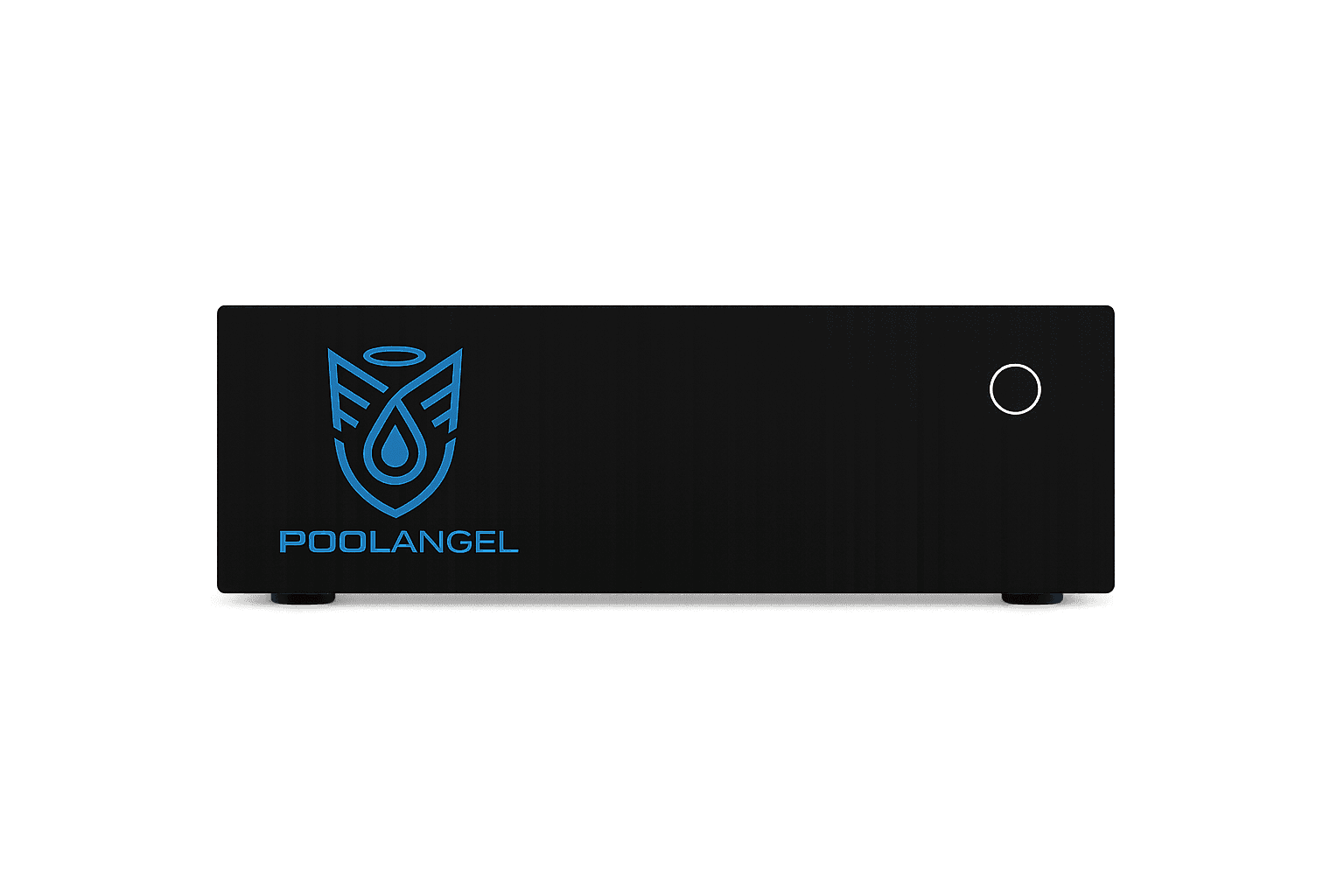
Edge AI means the artificial intelligence that analyzes your pool camera feed runs on a device at your property — not on a server hundreds or thousands of miles away. Pool Angel's Hub is that device. It receives the 4K video stream from your pool camera over a local connection and processes more than 10,000 signals per second using dedicated neural network hardware optimized for pool environments. The Hub performs body pose estimation, submersion duration tracking, and virtual pool geofencing locally — the same behavioral analysis described in our guide to how AI drowning detection works. When the system identifies distress or unsafe submersion, it sends an alert directly to your phone via your local network. No video leaves your property unless you explicitly enable optional cloud backup. This is the architecture Pool Angel's technology page was designed around from the ground up — not a retrofit of cloud software onto local hardware.
Video is analyzed on the Hub inside your home. Alerts reach your phone over the local network — no cloud round-trip.
Pool Angel edge AI: video stays local, alerts reach your phone in under two seconds.
Pool Angel Edge AI Advantage
Sub-2-second alerts. Local event logging. Continuous monitoring during Wi-Fi outages. Privacy-first design with no facial recognition by default. Pool Angel's Hub was engineered for on-device processing — not adapted from a cloud-first product. Explore our technology or order today.
How Cloud Pool Cameras Work — and Where They Fall Short
Cloud-based pool safety systems — including MYLO by Coral Smart Pool, SwamCam, PoolScout Pro, and most general security cameras with "AI" features — follow a fundamentally different data path. The camera captures video, encodes and compresses it, uploads the stream or clip to a remote server over the internet, waits for cloud-hosted AI to analyze the footage, then sends an alert back to your phone through push notification infrastructure. Each hop introduces delay and failure points. MYLO, for example, uses both above-water and underwater cameras with cloud-based analysis — a dual-layer approach that adds hardware complexity but still routes intelligence through remote servers. SwamCam and similar residential systems similarly depend on cloud round-trips for behavioral analysis. None of these competitors offer true on-device drowning detection processing in a residential Hub-and-camera package comparable to Pool Angel.
Cloud systems upload video for remote analysis. Each hop adds latency — and outages halt protection completely.
Cloud AI pool cameras: every internet hop adds latency before an alert reaches you.
The Latency Problem: A Technical Breakdown
Understanding cloud latency requires examining each stage of the alert pipeline. When a drowning indicator appears in the video frame — a head remaining submerged, a vertical body posture, minimal arm movement — the clock starts immediately. In a cloud system, Stage 1 is video encoding: the camera must compress the frame or clip, typically using H.264 or H.265, which takes 200 to 800 milliseconds depending on resolution and hardware. Stage 2 is upload: the compressed video must traverse your home network, pass through your router, and travel across the public internet to the vendor's data center. On a typical residential connection this adds 1 to 3 seconds; on congested Wi-Fi, shared hotel networks, or asymmetric upload speeds, it can exceed 5 seconds. Stage 3 is cloud queue and inference: the server must receive the upload, decode it, run the neural network, and classify the event. Server load, geographic distance to the nearest data center, and multi-tenant resource sharing add another 2 to 5 seconds. Stage 4 is alert delivery: the cloud service must generate a push notification, route it through Apple or Google notification services, and deliver it to your phone — another 1 to 2 seconds. Total typical latency: 5 to 15 seconds. In worst-case scenarios — storm-related connectivity issues, peak server load, or camera firmware retry logic — delays can exceed 20 seconds.
Edge AI collapses this pipeline. Pool Angel's Hub receives the raw or lightly processed video stream over a local wired or dedicated wireless link. Inference runs on dedicated accelerator hardware co-located with the camera feed — no upload, no queue, no geographic round-trip. Alert generation and local notification dispatch happen on the same device that performed the analysis. Measured end-to-end alert delivery is consistently under two seconds. The difference is not marginal optimization. The CDC notes that drowning victims often cannot call for help or wave for attention — meaning the only warning you receive is the alert from your system. If cloud latency consumes half of the 20-to-60-second intervention window before you even look at your phone, the practical value of behavioral AI drops sharply regardless of how accurate the cloud model might be in a laboratory setting.
- Video compression and upload (cloud only): 1–3 seconds typical, up to 5+ on slow or congested networks
- Cloud AI analysis and server queue time: 2–5 seconds, variable under peak load
- Push notification delivery back to your device: 1–2 seconds
- Total cloud latency: 5–15 seconds in normal conditions; higher during outages or congestion
- Pool Angel edge AI end-to-end: sub-2 seconds — camera to Hub to phone on local network
Edge AI vs Cloud: Side-by-Side Comparison
| Factor | Edge AI (Pool Angel) | Cloud-Based Systems |
|---|---|---|
| Alert latency | Sub-2 seconds (local inference + local alert) | 5–15+ seconds (upload + cloud + push) |
| Works during internet outage | Yes — Hub continues analyzing and logging locally | No — requires active cloud connection for AI |
| Video privacy | Processed locally; no upload by default | Video sent to remote vendor servers |
| False positive handling | Hub adapts to your specific pool environment locally | Generic cloud models; higher false alarm rates |
| Bandwidth usage | Minimal — alerts and metadata only | Continuous or frequent video upload |
| Scalability under load | Dedicated local compute per installation | Shared cloud resources; slower at peak times |
| Data sovereignty | Events stored on Hub, microSD, or NAS | Stored on vendor cloud infrastructure |
| On-device AI processing | Yes — purpose-built Hub hardware | No — competitors lack on-device drowning AI |
Edge AI vs Cloud: Who Should Choose What?
Edge AI (Pool Angel)
Pros
- Sub-2-second alerts — no cloud round-trip penalty
- Continuous monitoring during Wi-Fi and internet outages
- Video processed locally; privacy-first by default
- Local environmental adaptation reduces false alarms
- 99.7% detection accuracy with sub-0.3% false positives per Pool Angel FAQ
- Compliant with ASTM F2208 and NF P90-307; aligned with ASTM F3698-24 principles
Cons
- Requires Hub installation — slightly more setup than a standalone Wi-Fi camera
- Higher upfront hardware investment than basic cloud cameras
- Single-vendor ecosystem — not compatible with generic security camera apps
Who should buy: Homeowners, grandparents, and hospitality operators who prioritize the fastest possible drowning alerts, local privacy, and uninterrupted monitoring. If response time is non-negotiable, edge AI is the only architecture that delivers. Shop Pool Angel.
Cloud-Based Pool AI (MYLO, SwamCam, and similar)
Pros
- Remote video viewing from anywhere with internet access
- Lower upfront hardware cost on some models
- Vendor manages model updates centrally in the cloud
- MYLO offers dual above/below water cameras for layered monitoring
Cons
- 5–15+ second alert latency — consumes critical response window
- Monitoring stops entirely when internet connection fails
- Continuous video upload raises privacy and bandwidth concerns
- Generic cloud models produce more false positives and alert fatigue
- No on-device drowning AI processing — competitors lack local inference hardware
- Shared server resources can slow alerts during peak demand
Who should buy: Buyers who prioritize remote live viewing over alert speed, accept cloud latency trade-offs, and have reliable high-speed upload bandwidth. Not recommended as a primary drowning detection layer when sub-2-second response is the goal.
Privacy: Why Local Processing Matters
Your pool camera captures footage of your family, guests, children, and property. Cloud systems upload that video to third-party servers for analysis — creating privacy exposure that many homeowners and hotel operators find unacceptable, particularly in jurisdictions with strict data protection requirements. Pool Angel processes everything on the Hub. Events are logged locally to microSD or NAS. No facial recognition is enabled by default. Role-based access controls let you decide who sees what. For hospitality properties monitoring guest pool areas, local processing means drowning detection intelligence never transits through a vendor's cloud unless you explicitly choose optional backup. This is increasingly a compliance advantage, not merely a preference — and it is only achievable when AI runs at the edge.
Resilience: Monitoring That Never Stops
Pool Angel's edge AI Hub is designed for 24/7 operation with redundant systems and adaptive power management. When Wi-Fi drops — during a storm, router restart, ISP outage, or hotel network maintenance — the Hub continues analyzing video and logging events locally. Alerts queue and deliver the moment connectivity returns. Cloud systems have no equivalent fallback: when the internet fails, AI analysis stops entirely. Your pool is unmonitored at the exact moment you may need protection most. For hotels with shared network infrastructure and homeowners in rural or storm-prone areas with unreliable broadband, this resilience is a critical differentiator that cloud marketing materials rarely address honestly.
Consider a common scenario: a summer thunderstorm knocks out your router for twenty minutes while children are swimming under adult supervision. With a cloud system, those twenty minutes represent a complete gap in AI monitoring — no submersion tracking, no distress detection, no geofence alerts. With Pool Angel, the Hub continues every analysis layer uninterrupted. When the router reboots, queued alerts deliver immediately and local event logs capture the full timeline. For insurance documentation and incident review, that continuous local record is invaluable — another capability cloud systems only provide when the internet happens to be working.
Bandwidth and Hidden Cloud Costs
Cloud pool cameras impose a hidden operational cost that edge systems avoid: continuous upload bandwidth. A single 4K camera stream can consume 4 to 8 Mbps of upload capacity — enough to saturate many residential internet plans and degrade other household services. Hotel networks with dozens of IoT devices face similar congestion. Pool Angel's edge architecture sends only alert metadata and optional event clips over the network, not continuous video. The heavy compute and storage happen on the Hub. Over a year of 24/7 monitoring, the bandwidth difference is measured in terabytes — and the latency difference is measured in lives saved during the seconds cloud upload consumes.
Accuracy: Local Learning vs Generic Cloud Models
Alert speed means nothing if the system cries wolf constantly. Pool Angel's Hub continuously learns and adapts to your specific pool environment — accounting for water reflections, lighting changes at dawn and dusk, pool toys, landscaping movement, seasonal foliage, and camera angle variations. This local adaptation drives the system's 99.7% detection accuracy and sub-0.3% false positive rate documented on our FAQ page. Cloud systems use generic models trained on broad datasets that may not account for your pool's unique conditions, leading to higher false alarm rates and alert fatigue — the dangerous pattern where homeowners and staff begin ignoring warnings because most notifications are nuisance alerts triggered by wind, reflections, or pets. Research on AI lifeguard technology, including work summarized by Sentisight AI, confirms that machine learning models must be tuned to specific aquatic environments to achieve reliable distress detection — a task edge systems handle locally and cloud systems handle generically.
Industry Standards and What They Require
The pool safety AI field is maturing rapidly. ASTM F3698-24, published in 2024, is the first global standard specifically for computer-vision drowning detection systems in residential swimming pools. It defines performance criteria including response time, detection accuracy, false alarm rates, and environmental resilience. While the standard does not yet mandate edge versus cloud architecture explicitly, its response-time requirements align naturally with on-device processing capabilities. MYLO has positioned itself as a benchmark product under ASTM F3698-24, but its cloud architecture inherently struggles to meet the spirit of rapid response that the standard encodes. Pool Angel aligns with ASTM F3698-24 performance principles while exceeding them through edge AI latency advantages, and complies with ASTM F2208 and NF P90-307. See our pool safety standards guide for the full compliance landscape.
Do Any Competitors Offer True Edge AI?
As of 2026, the honest answer for residential and typical hospitality pool deployments is no. MYLO relies on cloud processing despite its dual-camera hardware. SwamCam, PoolScout Pro, and most residential pool AI products route video to remote servers. Some commercial platforms advertise edge capabilities in solar camera lines designed for large water parks and facility management — but these are not purpose-built drowning detection systems for home or hotel pool environments. Pool Angel remains the only system combining purpose-built drowning detection AI, on-device Hub processing, sub-2-second alerts, behavioral analysis (body pose, submersion, geofencing), and recognized safety standard compliance in a single integrated package. When evaluating competitors, ask one direct question: where does the drowning detection AI run? If the answer is "the cloud," you already know the latency penalty before you buy.
The Bottom Line on Latency
Cloud pool cameras were designed for convenience and remote viewing — not life-or-death response times. In a drowning emergency, five to fifteen seconds of added latency is not a minor inconvenience. It is a substantial fraction of the entire intervention window the CDC describes. Pool Angel's edge AI was engineered for one purpose: detect distress in milliseconds and alert you before seconds become irreversible.
Frequently Asked Questions
How much faster is edge AI compared to cloud pool cameras?
Pool Angel delivers alerts in under two seconds end-to-end. Cloud-based systems typically add 5 to 15 seconds of latency — and sometimes more on congested networks — due to video upload, server queue time, and push notification delivery. In drowning scenarios where the CDC estimates 20 to 60 seconds for intervention, that difference is critical.
Does Pool Angel work if my internet goes down?
Yes. The Hub continues analyzing video and logging events locally during Wi-Fi or internet outages. Alerts queue and deliver when connectivity returns. Cloud-based competitors stop AI analysis entirely when the internet connection fails.
Is my pool video uploaded to the cloud with Pool Angel?
No — not by default. Video is processed on the Hub inside your home. Events are logged locally to microSD or NAS. Optional cloud backup is available if you choose it, but drowning detection AI runs entirely on-device.
Why don't competitors like MYLO or SwamCam use edge AI?
On-device drowning detection requires dedicated neural network hardware, optimized models, and a purpose-built Hub — significant engineering investment that most vendors have not made. MYLO and SwamCam instead route video to cloud servers, which simplifies their hardware but adds latency and creates internet dependency. As of 2026, Pool Angel is the only residential drowning detection system with true on-device AI processing.
Does edge AI affect detection accuracy?
Yes — positively. Local processing allows Pool Angel's Hub to adapt to your specific pool environment, achieving 99.7% detection accuracy with less than 0.3% false positives. Cloud systems use generic models that cannot learn your pool's unique lighting, reflections, and layout as effectively.
Is edge AI required by pool safety standards?
ASTM F3698-24 does not yet mandate edge architecture explicitly, but its performance requirements for response time and reliability align with on-device processing. Pool Angel complies with ASTM F2208 and NF P90-307 and aligns with ASTM F3698-24 principles. See our standards guide for details.
The Bottom Line
In a drowning emergency, architecture is everything. Cloud pool cameras trade response speed for remote convenience. Pool Angel's edge AI trades nothing — you get local privacy, outage resilience, and the fastest drowning alerts available in a residential system. If you are evaluating pool safety systems in 2026, start with architecture, then verify accuracy and standards compliance. When you are ready to protect your pool with on-device AI, order Pool Angel or read our best pool safety cameras guide for the full market comparison. For a deeper look at what the AI actually detects, see how AI drowning detection works.
Protect Your Pool with the Industry's Best Edge AI
Pool Angel delivers sub-2-second distress alerts with on-device edge AI — no cloud round-trip, no missed seconds. 90-day money-back guarantee and free shipping worldwide.